Fundraising guide
I acquired this knowledge when fundraising for my degree, and I believe it should be universal so that success is less dependent on impudance. Originally intended for students going to prestigious universities with prestigious price tags, but can be possibly utilised for other purposes.
Step 0: What to keep in mind
- It may not work out, and it will ammost definitelly not go exactly as you planned - I know a lot of people who succeeded in fundraising on their own, and an almost equal amount that didn't.
- Always have a backup (a cheaper uni or some other occupation)
- It's not the end of the world when:
- I'm not gonna get into my first choice uni
- I'll get in a year (or more) later, especially in academia
- Eventually you will get into the occupation you want to do, meet interesting people and live an interesting life, being at a prestigious uni can help, but it is not a mandatory prerequisite
- So be humble (except for when presenting yourself to sponsors) and have realistic expectation
How to know if it's worth it?
Your possible benefactors are going to be asking this exact question: is the result worth the money?
- Consider if getting the same (probably cheaper) education in your home country is really not viable for the career path you are proposing (best if no comparable course exists) If the university is prestigious enough, the most valuable thing may be the people you meet there and opportunities you access.
The same question applies to you - your family may be able to support you, but (in my opinion), education at a specific institution in the 21st century is not worth beign hundreds of thousands in debt, selling of property or forcing you parents to take on more jobs.
Step 1: Reconnaissance - Get an overview of all available support
Get all the information about your course, especially its length and fees
your primary source should be the university website, but you can also try getting information from current students, some may write about their experience online or you can try contacting them directly
create a detailed budget of expected tuition, accommodation, travel, food, materials, leisure
Fees that you may not expect: visa, health insurance (mandatory health surcharge in the UK), bus/train passes, bike and its maintanance, storing items when you are away, kitchenware, event ticket fees (conferences, talks, socials)
Search systematically
- create a table TO KEEP TRACK of potential sponsors, here is the one i used:
| Type | Name | description | probability of support | estimated support | status | |
|---|---|---|---|---|---|---|
| FAMILY, PUBLIC (government), PRIVATE (philantropists, corporate), SCHOLARSHIPS | or other contact | how probable is it you are going to receive this? | how much would you get if you got accepted here | CONSIDERING, IN_PROGRESS, SENT, NEGOTIATING, RECEIVED, REJECTED |
- Search broad and deep, here are some methods:
- google, brainstorm with ai models
- use scholarship searching engines
- ask as many people as possible
- students coming from a similar background into a similar situation
- your future school's department (if there are multiple offices you can contact, send an email to all of them)
- alumni (of both your future and past schools)
- ask even the people you are contacting already for more contacts (Even if its not possible for you to support me, do you have any reccommendations on who I should contact?)
- Use personal connections if you have the opportunity - you friend knows someone rich? Try getting them to introduce you.
Step 2: Armament - Create an attractive, presentable profile
Compile a list of everything you did that's relevent to what you are fundraising for, then create a story of how it all makes sense
- If you did something seemingly unrelated, play that to your strenght by elaborating on a unique talent you can utilise in your field
- Put forward a tangible plan of what you want to focus on in the field. In a undergrad/masters it may be hard, but you cant just say you are going there without a plan. Of course don't feel obligated to follow through on it, potray it as a suggestion.
Focus on messaging the following: (but never actually say it out loud)
- you are perfectly suited for the studies (intelligence, education, motivation/grit)
- you are not just an ordinary student, you have unique talents that make you utilise the education in an even more potent way
- you sincerely want to make the world a better place and the only thing in you way is getting this extra education
- (optional if the sponsor would appreciate it): you want to return back and improve your country/city/region - this should be said aloud and specified
Think about who you are presenting yourself to
- how much do they know about your subject?
- They may admire something else than you based on their knowledge (e.g. you published something in a reputable journal and presented your research at a random conference abroad, but may want to speak just about the conference because the sponsors is not well-versed in academic journals)
- on the other hand they may be very knowledgable (or e.g. consult a proper scientist), so it cannot just be buzzwords and needs to mean something
- make them project themselves onto you, see their younger self in you
- are they succesfull businessmen? mention that you want to create a company/startup
- if they are older they may be more succeptible to personal stories, e.g. how a tragedy in your family motivated you to pursue this field
- how much do they know about your subject?
Prove everything you can
- when talking about anything, try to enumerate what it entailed (i organised this event with a budget of $10,000 for 150+ people, I worked on this project for 3 years, i did this many legal cases)
- provide links to articles/websites, pdfs of certificates
- get references from fancy sounding people ('renowned' scientist, CEOs of companies, directors of institutions)
- try to ask even your future school's department if they could provide a recommendation
- if you have something valuable without a certificate, e.g. a volunteering programme, make a reccommendation letter signed by someone you worked with
- it's also nice if a lot of good references come up just when googling your name, but that's not always possible (but you could put time into having at least a usable Linkedin so they know you are real)
Phrase to be authentic and consise
Step 3: Combat - Aproach and communicate with potential sponsors
The closer you can get the better
- can you approach them in person? at a fancy event, competition etc.
- Do you have their phone number?
- Can you get someone they trust to recommend you?
- Can you at least get their email from someone they know, so you can say I got your contact from XYZ as a form of recommendation?
- If none of these apply, you can always cold email the highest person you can get hold of, e.g. the CEO or owner of a company
- for getting personal emails of important people I recommend this website (after registration you get 5 free searches, they you could try creating a new account)
Even in the case of filling out scholarship forms, I recommend emailing or even calling the institution with a few well thought-out questions, so that they remember you and you stand out above other recipients in proactivity.
3.1 Write the first message
(you are probably going to be cold emailing this, but the same information can be also transferred in person)
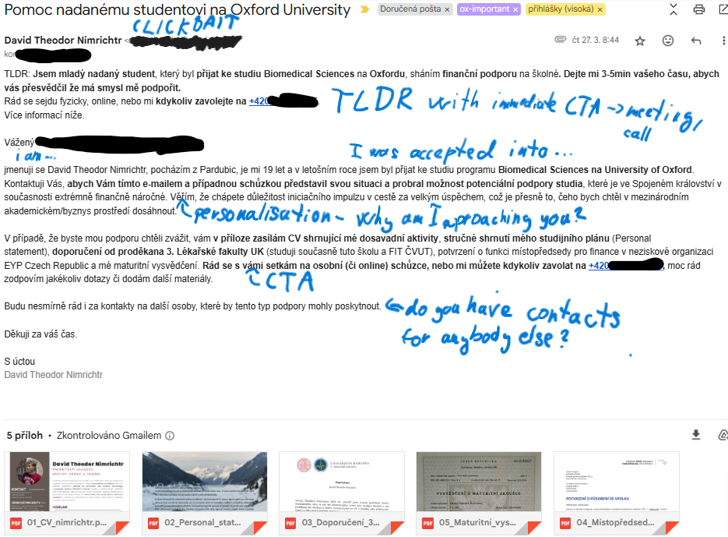
- make the subject a 'clickbait', them opening your message is half the battle (e.g. Help a talented student at XYZ uni)
- A very short 'too-long-didnt-read' (TLDR) of the whole message (optional, I would recommend it when messaging busier people like CEOs, it shows that you value their time)
- Introduce yourself and your situation in one sentence
- make it obvious at first glance that you are an interesting and smart person (e.g. young scientist working at a laboratory from the age of 14, it may be enough to say that you got into this prestigious school)
- 'Im contacting you to present my current situation and talk about the possibility of financial support' - do not mention the total buget in the first message (so they have to reply at least once)
- Call to action (CTA) - would it be possible to have a personal meeting / call? - dont talk about financial support directly yet, just about 'discussing the possibility of support' so they dont feel like they agreed to anything binding
- Attachments - to keep the main message short I recommend putting most of the content into attachements, which can be nicer and thus more readable documents than the email, here is what I included:
- Structured CV
- The fancy reccommendation letters
- Any specific certificates/exam scores, e.g. I included my perfect score on the czech secondary school final exams
- One page personal statement of your motivation and plans
- are they not responding? send out reminders (have you had the chance to look at my message from the 9th of April..)
also some technical notes:
- archive everything you write, so you dont have to come up with it again, e.g. create a single folder with documents for each application, then when you need to apply for more stuff in the future you can copy at least half from your existing applications
- Use ai as much as you want, but make sure it doesn't sound too AI-generated
3.2 Convince them in person
- Most benefactors will want to meet in person (probably in their own office), and thats where it's the easiest to convince them.
- During the meeting, be authentic (not just a dry academic), friendly but respectfull
- Make sure you know everything about the general scientific field, the course, all the costs, maybe even professors there that you want to work with or examples of people who have done something similar and are successful
- I have not prepared much for my meetings, but here's a small agenda you can follow:
- At the start ask how much time they have for you so you can accommodate the level of detail.
- Quickly introduce yourself in 5-10 minutes and restate the main motivation, making sure you really highlight all your strengths (they will probably have read at least some of the materials you sent)
- Leave the rest for a discussion, they are probably going to have a lot of questions, if not you can continue talking e.g. about why this specific school is the right fit for you (e.g. a unique education system)
- At the end make sure to define when they are going to get back to you (do not expect the decision to come right away).
3.3 Asking the general public (optional)
As this is quite time and effort intensive I would recommend trying individual contacts first, but if you really want to get the money and have no other options left, consider being very public about it and crowdfunding. This involves:
- First creating a place for all information about you and ways people can send you money, e.g. a personal website with a transparent account or a Gofundme page
- Being active on social media, e.g. making reels that explain your situation
- Reaching out to media outlets: doing news articles, interviews, public talks, going on TV etc.
- Convincing a lot of (famous) people to share your story
Crowdfunding can be very variable, to get really large sums of money from the general public you would have to go somewhat viral. It's simultaneously a good advertisement and you may get some philantropists to find you this way!
Step 4: Sort it out financially/legally
Always be fully transparent about your finances
- Tell each sponsor your full costs and that you would be happy for any support
- Be ready for them requiring proof of you family's assets and income.
- Assure them you are going to keep them updated about different funding you receive or other updates, and do so (e.g. an update e-mail every 2 months if its not urgent).
It is better to have more sponsors even if they propose to fund you more - you can use this willingness for more support later.
Make sure you are not overfunding. If you would get more money than you need, propose them to decrease their support so the amounts add up. And keep all the big receipts so you can prove this later.
Once you have enough sponsors on your side, its best to have a legal contract
- It can be very easy, with just specifying how much, for what purpose, and how they are going to support you, and what you have to do in return (e.g. if you stop studying they are not obliged to keep sending you more money)
- If you contact me I can provide you with some agreement templates.
- Make sure to sort out who pays the taxes (depends on the jurisdiction, paying for tuition fees is sometimes deductable, e.g. schools in the UK are charities)
4. Concluding notes
Even when you have a contract, keep in regular touch with your sponsors and build a strong relationship, e.g. by sending newsletters of you activities, meeting them in person or inviting them to come visit you.
Do you know someone who would benefit from knowing this? Share this page with them!
Want even more guidance or just found this interesting? Feel free to contact me.
If you speak Czech, you can also watch a Youtube Video of me giving some advice.
Are you from the Czech Republic or Slovakia and got into Oxford or Cambridge? Check out this scholarship programme i co-founded.
Now its up to you, GLHF!